
Cholitas' traditional costume as an instrument of cultural agency

What happens when a garment that was historically stigmatized at home becomes desirable abroad?
Opinions are widely divided on what is the proper way to wear polleras, not only in the Andean Altiplano but also abroad. Some take a more conservative stance, insisting that the correct way is the traditional one—no low necklines, no sheer fabrics— while others look to the future with the goal of bringing polleras not only to new generations but also to an international audience by reinterpreting and adapting the garment in a more contemporary way, while preserving its roots.
#CholaPaceñaFashion #IndigenousRepresentation #DecolonialFashion #CulturalTranslation #FashionStudies
Pollera women—also known by the historically pejorative term “Cholas”—are an ethnic group primarily referring to women from the Quechua and Aymara nations. Today, the term is applied to all women who wear traditional clothing established during the early period of cultural mixing in what is now Bolivia.
This traditional garment has its origins following the rebellions led by Tupac Amaru and Túpac Katari in 1872, which led the King of Spain to issue a decree requiring indigenous women of the Altiplano to adopt a particular style of dress, with the aim of making them forget their roots and enabling them to be identified within the caste system established by the Spanish. This attire consisted of ankle-length skirts, Sevillian shawls and high-heeled ankle boots. Is thought that Cholitas settled on their distinctive style of dress by around 1900.

There has been many changes in the traditional costume of the Pollera Woman, such as the number of accessories, the fabric, the shape, the embroidery, the jewelry, the hat, and so on; some of these changes happened as a response to the immigration to the cities, another were a consequence of following fashion trends, which has helped to encourage younger generations to carry on the tradition of wearing polleras, same principles, but with a trendier twist.
The wearing of these colorful, bulky gathered skirts means more than just a daily habit to protect themselves from the weather, it’s an act of resistance by its own, it’s the way of the Altiplano women to display proudly their roots, their creativity, their unique beauty, in contrast with the Eurocentric ideal of beauty impose by society. Wearing their traditional costume could even be called an art performance, the pollera is heavy, difficult to wash, the bowler hat also know as bombín or borsalino, doesn’t have a “proper” function like protecting from the sun of the wind, its function is to embellish, and it requires practice, it is placed at the top of the head, just like a crown, always with the risk of falling, to be able to wear a full pollera-style outfit women must move gracefully, elegantly, every move is calculated, to witness this is to witness a proper display of art.

Over time, clothing has evolved, as has its significance; although traditional dress was initially imposed as a means of control and segregation, the community has given it a new meaning, using it to represent themselves, foster pride, build identity, generate economic income, and shape their own narrative.
Photography taken by designer’s Facebook, by: Jaycko Productora Audiovisual Location:Gustu
And we cannot talk about this change without mentioning some of its greatest driving forces: fashion designers. The people responsible for ensuring that stigmatized indigenous clothing finds its way into international fashion vocabulary. Because what is truly interesting is not that a pollera has made it to New York, Paris or Tokyo, it is what happens to its meaning when it changes location.

In La Paz, it can convey a sense of belonging, class, femininity, status, Aymara identity, tradition and economic power. On an international catwalk, it may come to be interpreted as ‘fashion’, ‘ethnic’, ‘exotic’, ‘colourful’, ‘avant-garde’, ‘artisanal’ or ‘Bolivian’. And in the case of a bicultural designer such as Arisa Onaga, the same garment can also become a tool for reconstructing an identity from within the diaspora.
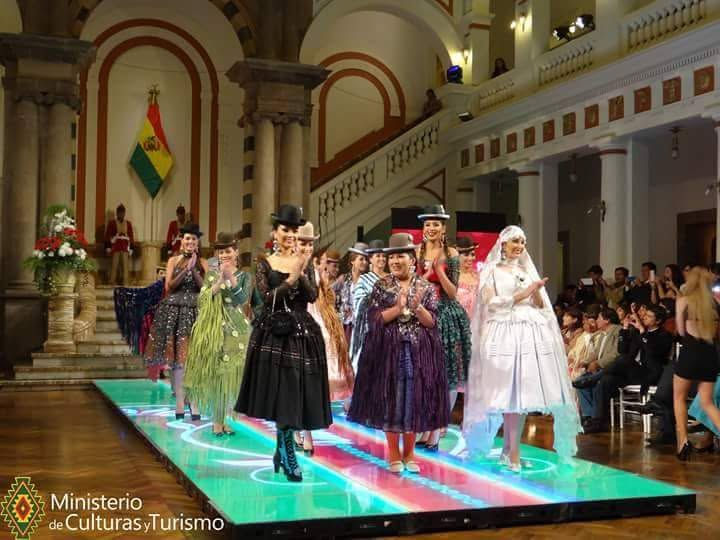
And amongst these very voices, we can hear different opinions, such as that of the designer Eliana Paco Paredes, who has gradually been breaking down that stereotype thanks to its ‘chola’ clothing line —which she debuted at New York Fashion Week in 2016, This is a major achievement for a style of dressing that has long been marginalized, and which was used to create social divisions and as an excuse to discriminate against those who wore it.

What Eliana aims to achieve with her designs is sophistication without losing their essence; she wants to show the world the beauty behind tradition and ensure that her designs are worn by Cholas in La Paz as well as by audiences in Europe, Asia and beyond.

In 2018 Renowned Bolivian designer and goldsmith Ana Palza, along celebrated Bolivian architect Freddy Mamani, and the iconic Chola Paceña had a collaboration for the Fondation Cartier pour l’art contemporain in Paris, as part of the program for the landmark exhibition Géométries Sud, du Mexique à la Terre de Feud, this event was turning point for the visibility of the Cholita, it was the first time traditional Aymara indigenous fashion and Neo-Andean architecture were celebrated on a major European haute couture stage.
Ana created a high-fashion show, with a collection consisting of over 40 distinct traditional looks. Her designs featured a line of intricate jewelry inspired by the grand Gran Poder festival, reimagined with elegant materials like pearls to celebrate indigenous artistry. The Models were six Aymara indigenous models (cholitas), who traveled from La Paz to Paris.
Unlike Eliana, Ana has a different perspective about who should wear the pollera, after her participation in Cartier’s multidisciplinary program she was questioned about her future plans, her response was bit vague: ‘I don’t know, I am working gradually,’ she said. ‘I am not planning anything. I am not doing this to make money or to win – it is a real passion.’ She has also been invited to Spain to show her collection, but at she can bring genuine cholita models, she said she’ll decline. Her designs are for the mujer de pollera to wear, not for a model to appropriate. ‘If we travel somewhere, we are bringing the mujer de pollera with us,’ she insists. ‘It is the woman who represents what we do. This is what we show, the entire woman. – with her essence... This is not only about the clothes – the mujer of pollera is not an item – this is about the woman.’
Presentation by Ana Palza for Fundación Cartier:
Which leads me to the main question, What happens when a garment that was historically stigmatized at home becomes desirable abroad? Whilst the beauty behind the layers of the skirts, the textures, colours and details of the fabrics, as well as the whole array of accessories that come together to form the traditional Cholita costume, are steeped in history and struggle, it is our duty as fashion consumers to appreciate it with respect, without neglecting its historical and social context, and to remember that behind the artistry of the clothing there are real people who, sadly, have been marginalized simply for being who they are.
When a culture begins to be consumed primarily for its difference, ‘otherness’, colorfulness or supposed authenticity, separating it from its historical and social context, it becomes subject to exoticization. We can always admire with respect and awareness, draw inspiration and even consume without appropriating or exoticizing.
—By Carla Campos
Continue the Journey!
To explore further: Collection “Pachamama” by Elina Paco:


Comments