
Art as Resistance
Updated: Jul 8

Nana Akosua Hanson’s Afrofuturist Revolution
What if the most radical thing you could do was imagine a different world — and then
draw it?"
Super-heroines fighting systems, not villains
In most superhero stories, the formula is familiar: a villain threatens society, a hero steps in, and order is restored. The conflict is personal, dramatic, and solvable within a few pages. But what happens when the enemy isn't a single person? What happens when it's corruption, patriarchy, or environmental collapse? That's the question at the heart of Moongirls, the graphic novel series created by Ghanaian writer and multimedia artist Nana Akosua Hanson.
In this series, art is not treated as entertainment. It is a lens, a language, and a form of resistance. Across comics, feminist organizing, and community-based interventions, Hanson's practice suggests that changing society begins with changing the stories people believe about it.

Hanson is a writer, feminist organizer, radio host, and multimedia artist. Across every medium she works in, one belief remains constant: creativity is a form of power.
Her work is centered around the idea that communities can reclaim agency by recovering memory, questioning inherited narratives, and envisioning futures on their own terms. For Hanson, art and activism were never separate worlds. Creativity is how you challenge the stories that make injustice feel inevitable and replace them with something else.
When comics become resistance
Moongirls features four African super-heroines whose struggles reflect realities rarely seen in mainstream superhero fiction. The series centers African heroines as protagonists of their own political and social realities. Unlike other superhero narratives, they don't fight supervillains. They confront the systems that shape everyday life such as corruption, religious extremism, gender inequality, and environmental destruction.
(Courtesy of Moongirls)
It gives visible space to LGBTQ+ characters not as symbols or sidelines, but as active participants in imagining the future. It engages directly with environmental and social concerns that dominant comics culture tends to ignore.
Sketches and work-in-progress materials for Moongirls
(Courtesy of Nana Akosua Hanson, Illustration by Hanson Akatti)
Guiding all of it is the Ancient Egyptian Kemetic principle of Ma'at associated with truth, balance, justice, and harmony. The Moongirls are not trying to dominate. They are seeking equilibrium in societies shaped by injustice. Heroism, in Hanson's hands, becomes an act of repair.

To understand Moongirls, it helps to understand the movements it belongs to:
Afrofuturism
Afrofuturism emerged largely from the African diaspora, using speculative fiction, mythology, and science fiction to imagine alternative futures for Black communities globally and rethink history. It reclaims narratives long distorted by colonialism and erasure.
Africanfuturism
Africanfuturism shifts an important question. Instead of asking how Africa fits into someone else's future, it asks what futures emerge when Africa becomes the point of departure.
Both movements share a core belief: African futures should be imagined by Africans, and grounded in African experiences, histories, and cultural knowledge. Moongirls embodies that belief. Its worlds are not borrowed from Western visions of progress. They are built from local realities and ancestral knowledge.
Art in action
Hanson's work does not stay on the page. It is part of a broader strategy for social intervention.
In 2016, she founded Drama Queens, a feminist collective creating spaces where women and queer individuals can share experiences that are often excluded from public discourse. Workshops, performances, and community events become platforms for storytelling and collective dialogue.
Her practice extends into anti-corruption initiatives and regional creative hubs, where artists, journalists, and activists collaborate to address systemic issues through creative methods, using satire, performance, and visual communication to make political problems more accessible and discussable.
For Hanson, community-based artistic interventions are not supplementary to the political work. They are the political work.

SHEROES and global visibility
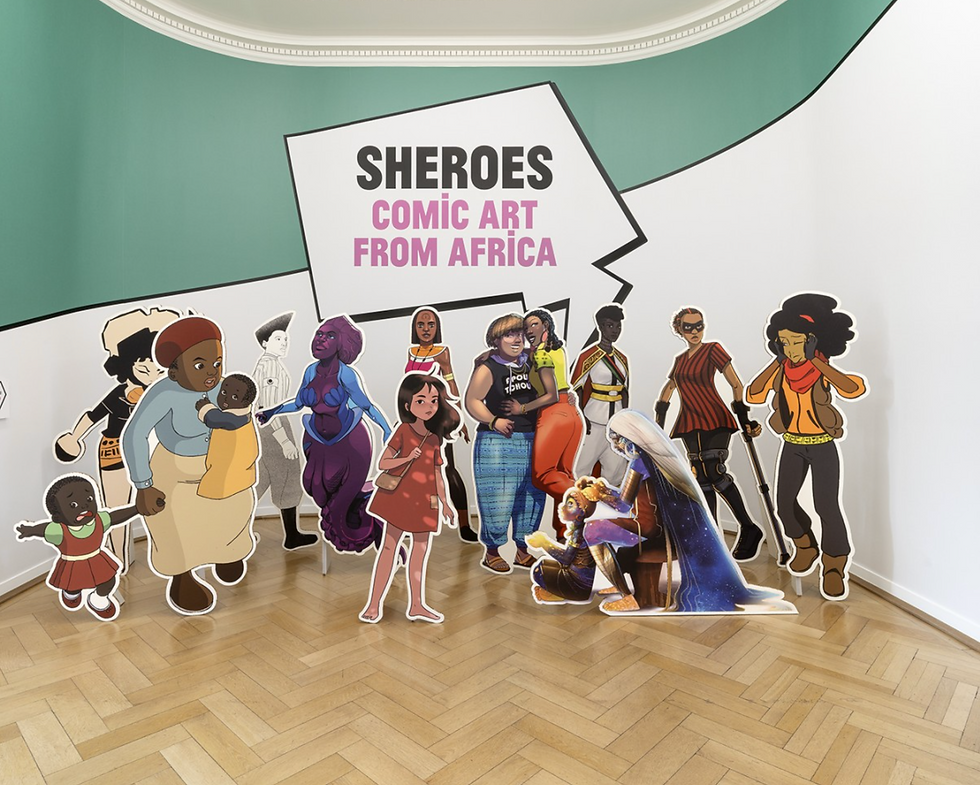
SHEROES:
Comic Art from Africa is an exhibition that represents a symbolic milestone in the growing international recognition of Hanson's practice.
More than an exhibition, it is a statement about where powerful cultural narratives can come from.

For decades, global superhero culture has been dominated by a handful of countries and industries. African characters appeared at the margins, if they even appeared at all. By placing African heroines and African perspectives at the center of international conversations, SHEROES expands not only representation, but the range of futures the world considers worth imagining.
The "Sheroes: Comic Art from Africa" exhibition in Frankfurt, Germany
(Courtesy of Nana Akosua Hanson and Weltkulturen Museum)
How art becomes a tool for social transformation
Hanson's work suggests that social transformation does not begin only in governments, institutions, or protests. It also begins in the stories societies choose to tell about themselves.
Through Moongirls, Drama Queens, anti-corruption initiatives, and platforms built for marginalized voices, Hanson demonstrates that imagining a better future is a way of building it. If injustice depends on making certain realities appear natural and inevitable, then art has the power to interrupt that and to open space for something different.
Superheroes are often imagined as people with extraordinary powers. Hanson's work proposes something different: the most radical power may be the ability to imagine a future that existing systems insist is impossible. That is where transformation begins, long before it becomes policy, protest, or reality.
Maybe the real question isn't whether art can change the world, it's what world we'd build if we let ourselves imagine one first.
by Valeria Lupo
Continue the journey!
Read the moongirls novels:
Related events: Social media:
Drama Queens instagram:
Nana Akosua Hanson instagram:


Comment:
This is an interesting discussion about resilience and how people respond to challenging circumstances. I like the emphasis on adapting, learning, and continuing to move forward rather than giving up when things become difficult. That same focus on preparation and confidence is important in workplace safety, where AI Forklift Training Ltd helps operators build the knowledge needed to work safely.
Really powerful perspective on art as a form of resistance. The way this piece explores Afrofuturism, identity, and challenging larger systems makes the article both visually striking and thought-provoking. Creativity can reshape how people see the world, just as attention to detail matters in everyday services such as Carpet Cleaning Vaughan. Thanks for sharing such an inspiring feature.
Al buscar información sobre magis tv, creo que es importante encontrar explicaciones que realmente ayuden al usuario. Conocer sus funciones, compatibilidad y requisitos permite tener una idea más clara de lo que ofrece y de qué se necesita para utilizarlo correctamente.
Found this while looking for quick browser games. The eggy car online version runs smoothly and is fun for short breaks.