
Mexican Youth Countercultures
Updated: Jul 10

The New Aesthetic Codes
More than clothing, fashion is a visual language that reflects the identities, struggles, and social changes shaping each era.
What does Counter Culture mean?
"a way of life and a set of ideas that are completely different from those accepted by most of society, or the group of people who live this way”
The Cambridge dictionary
Over time, we have witnessed major countercultural movements such as punk, which, whilst a movement of great political and social significance, was defined by a key element: the aesthetic code of dress, originating in the mid-1970s in the United States and England. It emerged as a visceral countercultural response to commercial music, social conformism, and economic crisis. Its main characteristics were a rebellious attitude, a philosophy of self-management, and a raw sound. The British explosion took place between 1975 and 1976, against a backdrop of deep crisis, strikes, high unemployment, and a lack of opportunities for young people. Like many others, this movement transcended its status as merely a movement to becoming a way of life, and we cannot talk about punk without mentioning the mother of streetwear by excellence, or perhaps the Queen of streetwear? Vivienne Westwood, a working-class girl from Cheshire, fashion school dropout; she was disruptive from the beginning, designing clothes for the “Teddy Boys” (period’s British subculture, preceding punk movement), but soon she would rebrand herself and find a new audience, “grunge rock fans”. Here’s when she helped shape the aesthetic of the entire punk rock movement; she was dressing in the “Sex Pistols”, which was really provocative at its time, with the t-shirts using the Queen’s face, many were offended, and considered it a disrespect to the crown.
Vivienne was undoubtedly a key figure in this movement, as clothing is the way we present ourselves to the world, without using words; it is our identity, showing where we come from, who we are, and what we want to express directly and simply. She helped to raise the profile, and to define the aesthetic of one of the most important countercultural movements in history.
We could go on to discuss many more movements that have helped shape fashion over the years, such as the Beat Generation in the 1950s, the hippie movement in the 1960s, and the Teddy Boys themselves in the early 1970s, but today we’re going to talk about a couple of new cultural movements amongst Mexican working-class youth, their origins and their aesthetic codes.
Meximalismo
This movement is not just a design trend; it is a cultural manifesto that celebrates excess, history and the complexity of Mexican identity, transforming everyday chaos into a refined art form.
It is a contemporary aesthetic movement that stems from the combination of the concepts of Mexico and maximalism.

Unlike minimalism, which prioritizes simplicity and the reduction of elements,
Meximalism is characterized by visual abundance and the intense use of colors, textures, symbols, and Mexican cultural references.
More than just a decorative trend, it is a manifestation of cultural identity that seeks to celebrate the richness, complexity, and diversity of Mexican culture.

It is distinguished by its narrative nature, as every object, color or element incorporated into a composition carries symbolic and historical significance. This aesthetic combines traditional and contemporary elements, allowing handicrafts, indigenous textiles, popular iconography, religious art and modern design to coexist within the same space or garment. Thus, the accumulation of elements is not random, but stems from the intention to tell stories related to cultural fusion, collective memory, cultural resistance and national pride.
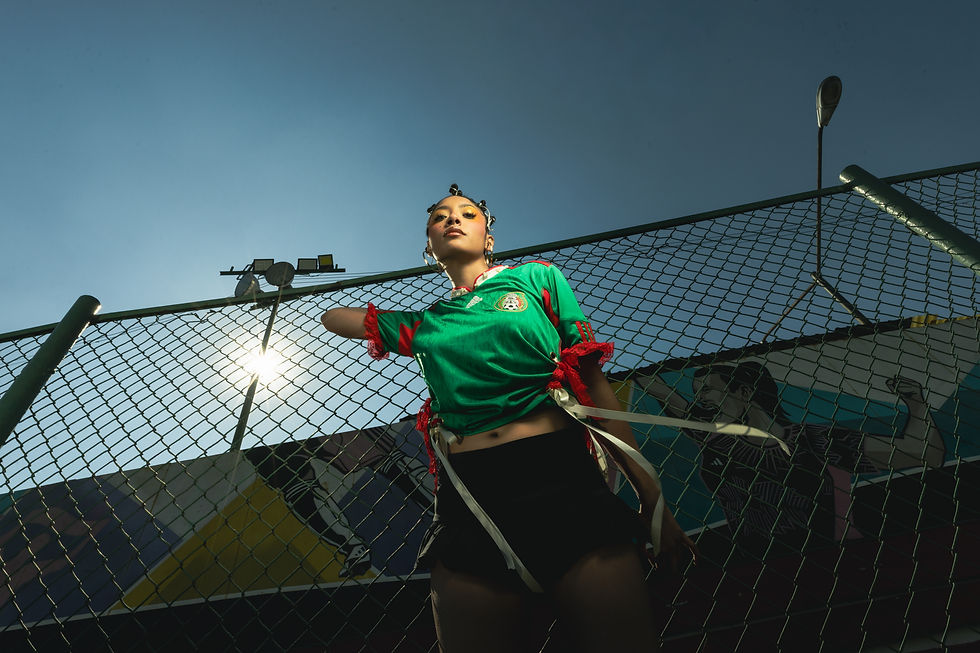
Its roots lie in various Mexican cultural expressions. Among these, the New Spain Baroque stands out, whose excessive ornamentation influenced a preference for visually saturated spaces; popular graphic art, seen in markets, shop signs and street posters, which introduced vibrant colors and accessible visual languages; and a reaction against globalization and aesthetic homogenization, which prompted Mexican designers to re-evaluate traditional elements that were previously considered popular or kitsch.
Key elements of Meximalism include the use of a saturated color palette, particularly Mexican pink and other intense colors; the principle of horror vacui, that is, the tendency to avoid empty spaces; the combination of artisanal and luxurious materials; the incorporation of religious and popular symbols reinterpreted from an aesthetic perspective, and the superimposition of multiple textures and visual layers.

Although Meximalism existed as an aesthetic practice before it was formally defined, it was Mexican stylist Dixy Rodríguez who coined the term and established it as a conceptual category.
Meximalismo Manifesto:
“It’s not a trend, it’s an identity.
Meximalismo is a cultural and visual movement
born out of collective identity.
From the everyday, from the popular,
from everything that for years was called ‘too much’.
It doesn’t seek to simplify.
It doesn’t seek to fit in.
Meximalismo exists to show who we are.
What many called “too much”
Is exactly who we are”
-Dixy Rodríguez, 2023.
New Counterculture Movements in the Mexican Culture
Meximalism as a new cultural code cleared the way for new movements, which drew on elements of this new term as an aesthetic reference when defining their dress codes.
We are talking about the movement Aztetic, a movement defined as the art of claiming the spaces that were denied to us. This term is a mix of the words ‘aesthetic’ and ‘Aztec’, which has emerged strongly, proposing the embracement of fashion and trends without abandoning your cultural identity, by reinterpreting elements that already exist within Mexican culture. It’s a bit like seeing the ‘aesthetic’ in everything we were told wasn’t.

Wess Montoya, Mexican illustrator coined this term after noticing that some people were using the word ‘Aztec’ as a classist and racist slur on social media, particularly when people with darker skin tones tried to set fashion and beauty trends.
“Aztetic stems from a painful realization for me, which was understanding that we cannot even be free or be part of things that exist in the world… That’s why the idea is to challenge trends and attitudes that tell you to abandon who you are, because you don’t belong”
-explains Wess.
Another new movement is Tumbette, term coined by Suzette, Dj and stylist from Sonora, Mexico, which is a blend of feminine and masculine elements in regional Mexican music.
Tumbette also emerged as part of the neo-buchonism movement, gaining momentum when ‘coquette’ (a hyper-feminine and flirtatious aesthetic) became established on a global scale.
The inspiration behind Tumbette emerges from the music genre called ‘corridos tumbados’, a sound originally from the border region of Mexico, mixing trap with corridos.
These movements don’t seek to fit into traditional, conservative, nor external narratives, these movements are the option in a world where global trends are trying to dictate how we should look, what’s beautiful, what’s accepted, what’s good, trends that try to erase uniqueness and diversity, because it may be uncomfortable to some, trying to fit everyone into a mold of what’s aesthetically correct to be part of.

The significance of these movements lies in bringing to light the daily lives of Mexican youth, creatively reinterpreted through their clothing, thereby creating new aesthetic codes and contributing to the evolution of fashion and what is considered ‘Mexican’ today.
It is an aesthetic revolution;
It is resistance and pride.

by Carla Campos
Continue the journey!
Related events: Social media:

Photographer Instagram:
Photographer Facebook:


Me parece bastante útil encontrar información clara sobre loterias mundiales, especialmente cuando los resultados están organizados de forma sencilla. Esto facilita la consulta, permite comparar diferentes sorteos y ayuda al lector a encontrar rápidamente los datos que necesita sin tener que revisar numerosas páginas.
Really useful information. I often find educational tutorials and learning resources online, and a pinterest video download tool can be helpful for keeping useful content for future reference.
Found this while looking for quick browser games. The eggy car online version runs smoothly and is fun for short breaks.