
Somewhere Between Heritage and Transformation

What happens when heritage remains alive through transformation?
We often treat heritage as something to leave untouched. Resilience by Ariana Gjoni, a fashion designer based in Pristina, Kosovo, turns old traditional wool into something new to wear.
Her latest exhibition, also called Resilience, left many people stunned, or maybe just asking one thing: how did she do this? To understand it better, we sat down with Gjoni herself.

She starts with the name. “Resilience is the ability to endure, adapt and transform without losing one’s identity,” she explains. For her, it comes down to continuity: “the capacity of material, craft and cultural memory to change and still remain recognizable.”

Working with Kosovar and Albanian culture is personal for her, and she takes it seriously. Zhgun, shojë, plis and sumbulla are at the center of the collection, and all of them come from that heritage. She knows where copying ends and reinterpreting begins. “What interests me is not reproducing traditional dress, but understanding its essence and asking what it can become today.” In her hands they become “starting points for new forms, textures and silhouettes.”

Her way of seeing comes from architecture, which she studied for two years before moving into fashion. “Architecture taught me to think in terms of structure, proportion, volume, balance and space,” she says, and she still looks at garments this way. Inspiration usually starts with something small, like a texture, a construction detail or an old object, and grows while she works. “I think my inspiration ultimately comes from looking at what already exists and imagining what else it could become.”
Then she had to test that on the fabric.

She worked with "zhgun" and "shojë", traditional wool made some 40 to 45 years ago with artisanal techniques that are rarely practiced today. There was no sketch at the start. First she spent time getting to know the wool: its weight, texture, structure and limits. Every garment was draped straight on the mannequin, because the wool is so heavy and rigid that it had to help decide the form.

Everything was made by hand, with large needles and strong thread, and after four decades some areas were so fragile they could fall apart if touched too much. Even her workspace had to change, since old textiles release fibres and dust. “They cannot be treated like contemporary fashion textiles; you have to understand their limits and respond to the way they behave.”

That negotiation was also the hardest part. Sometimes she had a clear silhouette in mind and the fabric just refused. “I think that was the hardest thing to get right: knowing when to insist on an idea and when to let the material change it.” The turning point came when she stopped forcing the wool to act like a normal fashion fabric. “There was a moment when I stopped trying to make the material behave like a conventional fashion fabric and started listening to what it was telling me. That changed the entire process.”
Her ritual for all this is simple. What she needs most is calm and uninterrupted time to experiment, make mistakes and change direction. She sums it up in a few words: “coffee, music, solitude, and a conversation with the material.”
Then came the question of where to show it, and she chose the Museum of Kosovo. “The museum was not simply a venue for the collection; it became part of its meaning.”
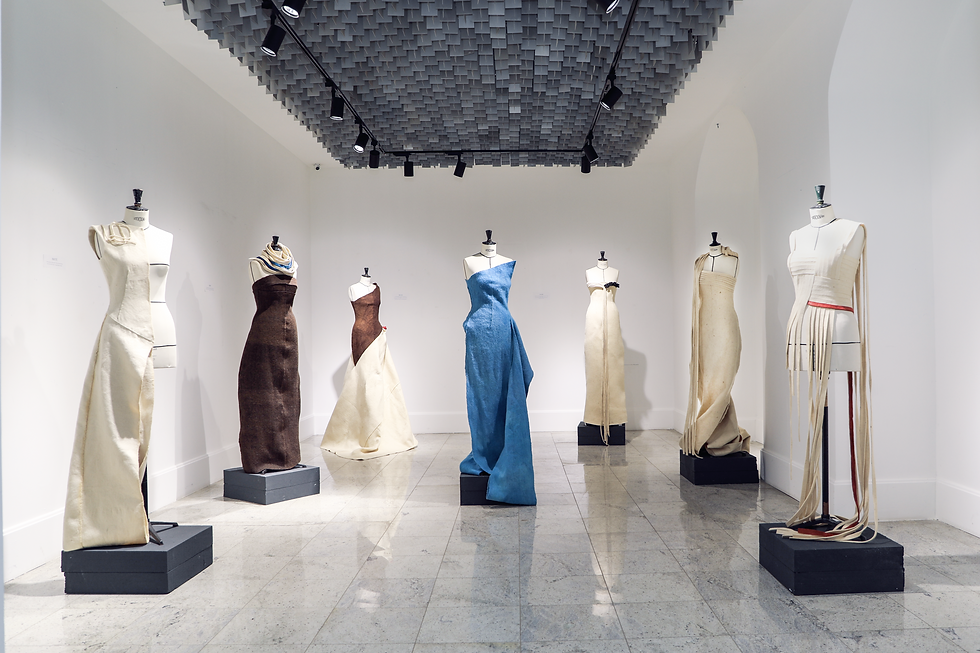
A museum protects the past, and her garments ask if heritage can stay alive by changing. “The past was present, but it was not static. It had been transformed, worn, and brought into the present.”
Her references go well beyond fashion. Alexander McQueen showed her how fashion can tell a story. Madeleine Vionnet’s idea of “allowing the material to reveal the form rather than imposing a form upon it” is very close to how she drapes. Santiago Calatrava’s structures echo her architectural thinking, and Roland Barthes’ The Fashion System taught her to read a garment like a language.
The piece that shows all of this best is Akullimë, the showstopper of the collection. It is made from dyed zhgun in a bright blue that stands out from the natural tones around it, and the name comes from "akull", the Albanian word for ice.

The neckline is asymmetric, rising over one shoulder and leaving the other bare, and the fabric opens into a big drape on one side, so the dress seems to move even when it stands still. At the hem, the zhgun gathers on the floor and shows how heavy and textured it is.

Old wool carries the memory of the people and techniques behind it, and here it gets a completely new look. For Gjoni, that is what Resilience is about: “the ability to change and express something new without losing one’s identity.”
As for what comes next, she wants to create things “people value enough to preserve,” design that is worth keeping for longer than one season. “I don’t see Resilience as a closed collection,” she says. “I see it as the beginning of a much longer exploration of how we can carry the past forward without being bound by it.”
Written by Renea Sanaja


Comments