
What the Chair Became

Where does a sculpture begin, with an idea, or with a chair you happen to be sitting on? Most stories about art go in one direction: the concept comes first, then the hands follow.
For Gresa Gashi, a young sculptor based in Pristina, Kosovo, the answer sits somewhere in the middle. She had a direction early on, but the pieces took their shape from whatever crossed her path in the studio: an office chair, a head-shaped rock, a pile of paper spines from a library delivery.
"I think the easiest way to talk about these works is how they came about," she says. Sculpture was always the medium that let her say what nothing else could. "Modeling, building and clustering materials to have a finished project is, in a way, how I imagine my consciousness was built."

The direction came from Boccioni's "Unique Forms of Continuity in Space" (1913), which led her to Giacometti's post-war bronzes and his "Walking Man II" (1960). She wanted a walking man of her own, and that became a series of works made from wires, paper spines, plaster "and whatever I could find," a mix of "futuristic, dark, maybe dead androids."

The everyday things around her mattered just as much, "what I was reading at the time, watching, and especially listening to."
She was working as a librarian then, and one day a shipment of books arrived from England with thick strips of paper packed in the boxes, each with an origami-like spine. "I was like, of course, I'll take them all." They sat in her studio for a month before she used them. Eventually they ended up in the sculptures "looking like actual black-painted hard bones."

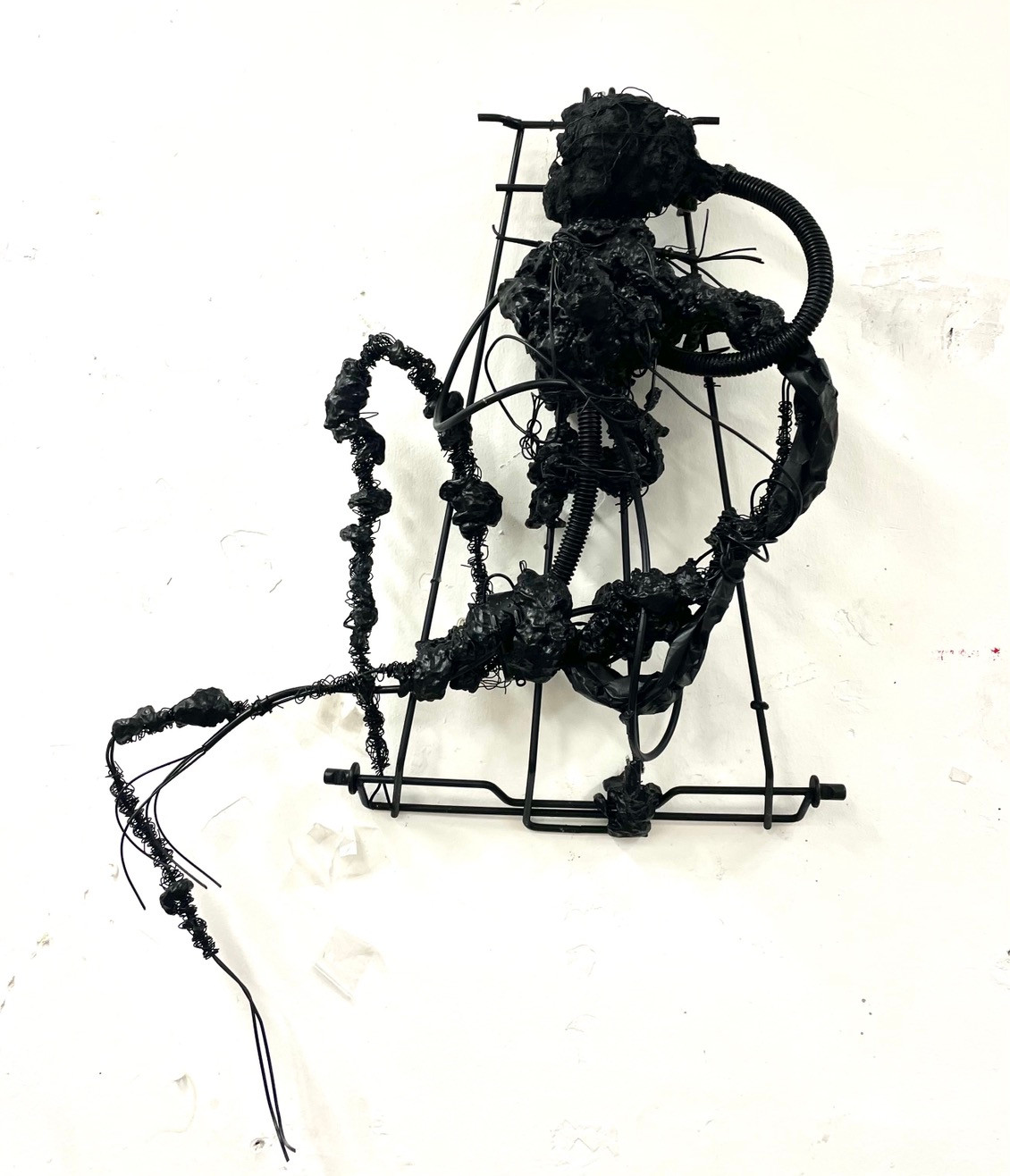
For a while nothing made sense. "It was hard to grasp what was going to become, so I just gave up and kept accumulating different materials." When the studio got too full, she had to clear it and her head along with it. What stayed was plaster, rebar, insulation foam, black corrugated tube, paper spines and a lot of wire. Spraying everything black finally pulled it together: "it made it somehow cleaner, more real and easier to work with."
The Relike series came first. Relike 3 started almost by accident, late one night: "I started doing Relike 3 as a distraction, where I ruined a perfectly good spinning office chair I was sitting on." What came out of it was a "crouched down skeleton with its spine high up, melted down flesh and stomach, loose head and one of the chair's wheels as an eye hanging down in this organic matter."

While it was taking shape she found a rock shaped like a head, which became
Relike 1, the first finished, black-painted piece. Relike 2 came quickly after, and it is the only one in the group that started from a sketch.

The largest piece, Van Gogh, grew out of a ruined table and a plastic ball. She built another droid melted into the base of the table, "like the fossils of an ancient patient," with wires and melted iron for remains.
The name came from someone else. Her professor, the sculptor Ismet Jonuzi, walked into the studio, took her Walking Man from the door where it was holding it open, and placed it on the table. Then he picked up an empty black frame that was lying around and set it over the shoulders, "as if it were holding a painting." She says, "I agreed immediately."

Sun sits outside the series. It is her first work and also her last, and it began as material hung on the wall and filled in little by little.

Two prints are sewn into it, a man looking at a sun so bright it makes his flesh fall off. "I used orange to sew it, a string of warmth, I guess." Spray paint from the other sculptures ended up on it, along with leftover wire and pieces of old work. "Sun was my sketchbook on the wall, in a way. It was my trial and error." She even burned the edge on purpose, out of boredom.

Science fiction was in her head the whole time, and she describes herself as "very much into science fiction novels and the futuristic aspects of them." Her week had a rhythm too: studio work, then a surprise screening at the local cinema, where she would sometimes sleep through the movie or land on a great idea "that would leave as soon as I became aware of it.

A very addictive feeling." Somewhere in all of this, "a story was created on its own by just working around the same material and concepts."
Looking at the finished pieces, the movement is easy to spot. "The works are always in a stance of movement, crouching, bending, reaching, or even taking a step. To what, to whom and why is something I still want to explore in sculpture."
For now she is turning to painting, "on very past concepts and ideas that rest in memories, while returning to the future aspects of sculpture." She is still working out where she wants to go with it: "I am still wondering what medium will be sitting in my present and where will that lead."
Written by Renea Sanaja


Comments